
How Much Does It Cost to Refinance a Mortgage in 2026?
How much does it cost to refinance a mortgage? Most homeowners pay between 2% and 5% of their loan amount in closing costs — on a $300,000 loan, that’s roughly $6,000 to $15,000. The exact figure depends on your loan size, location, lender, and whether you roll costs into the loan or pay them upfront.
This breakdown covers what’s actually included in refinance closing costs, how lenders arrive at your specific number, and whether rolling costs into your new loan or paying them upfront makes more sense for your situation. Because closing costs move with loan size and location rather than with mortgage rates, the percentages below hold steady year to year — run them against your actual numbers with our Refinance Calculators to see where you stand today.
Last updated: September 2026
What’s Included in Refinance Closing Costs
Refinance closing costs aren’t one fee — they’re a bundle of separate charges from your lender, the title company, and local government. The typical ranges:
Loan origination fee. Usually 1% to 1.5% of your loan amount — this is what the lender charges to process and underwrite the loan.
Appraisal. Generally $300 to $700, though it can run higher for larger homes or rural properties where comparable sales are harder to find.
Title search and title insurance. Typically 0.5% to 1% of your loan amount. This protects the lender (and optionally you) against ownership disputes or liens that surface after closing.
Credit report fee. A small cost, usually $10 to $100 depending on how many borrowers are on the loan.
Recording fees. Charged by your county to officially record the new loan — usually $25 to $250.
Discount points (optional). Each point costs 1% of your loan amount and buys down your interest rate. Not required, but it’s the one line item you have direct control over.
Attorney or settlement fees. Required in some states, optional in others — typically $500 to $1,000 when applicable.
Add these up and most refinances land in the 2% to 5% of loan amount range cited above. A cash-out refinance usually costs more than a standard rate-and-term refinance, since lenders treat the larger loan balance as higher risk.
Rolling Closing Costs Into Your Loan vs. Paying Upfront
How much does it cost to refinance also depends on how you choose to pay for it — you generally have three ways to cover the bill:
Pay in cash at closing. This keeps your new loan balance as low as possible and minimizes total interest paid over the life of the loan — the cheapest option if you have the cash available and plan to stay in the home past your break-even point.
Roll costs into the loan balance. Your closing costs get added to your principal instead of paid out of pocket. You pay interest on those costs for the life of the loan, which raises the true cost over time — but it keeps cash in your pocket now.
Take a lender credit (“no-closing-cost” refinance). The lender covers your closing costs in exchange for a slightly higher interest rate. You’re not avoiding the cost — you’re paying for it through a higher rate instead of upfront cash. This can make sense if you don’t plan to keep the loan long enough for the rate difference to outweigh the savings.
Note: This analysis is for informational purposes only and does not constitute financial advice. Your specific situation may differ — consult a licensed mortgage professional before making refinancing decisions.
How Do I Calculate My Break-Even Point on Closing Costs?
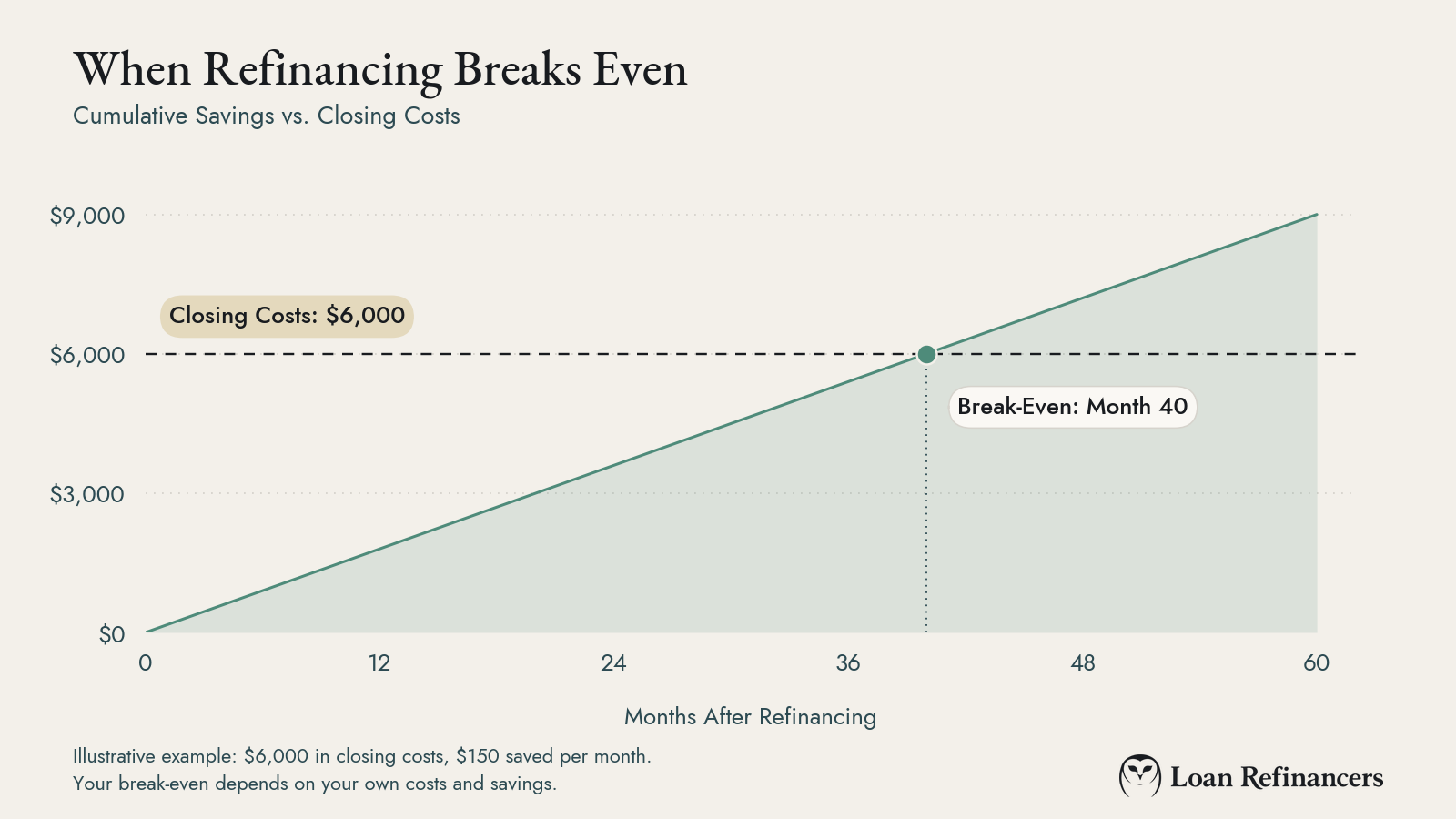
Your break-even point is the month when your monthly savings from refinancing add up to more than what you paid in closing costs:
Closing costs ÷ monthly savings = months to break even
A homeowner paying $6,000 in closing costs who saves $150 a month breaks even in 40 months — a little over three years. If they’ll stay in the home longer than that, the refinance pays for itself. If they’re planning to move sooner, it doesn’t.
Rather than estimate this by hand, our Refinance Calculators run the math automatically against your actual loan balance, rate, and estimated closing costs — no signup, no credit check.
What Affects How Much It Costs to Refinance
How much does it cost to refinance in your specific case? The 2% to 5% range is a starting point, not a guarantee — a few things move your actual number:
Loan size. Costs scale with your balance even though the percentage stays roughly the same — a $500,000 refinance costs more in dollar terms than a $200,000 one, even at an identical percentage.
Location. Some states require attorney involvement at closing; others charge transfer or recording taxes that others don’t. Title insurance rates are also set at the state level in many places.
Loan type. Government-backed streamline refinances (FHA Streamline, VA IRRRL) typically waive the appraisal and cost less to close. Cash-out refinances typically cost more.
Your choices. Buying discount points raises your upfront cost. Shopping multiple lenders and comparing Loan Estimates side by side is the most reliable way to bring origination and title fees down — these are two of the few line items with real room to negotiate.
Is It Worth Paying to Refinance?
The real question isn’t how much does it cost to refinance in isolation — it’s whether your rate gap and timeline clear that cost. A $6,000 closing cost bill is a good trade if it saves you $200 a month and you’re staying put for five years. The same $6,000 is a bad trade if you’re moving in eighteen months. (For the full walkthrough on weighing your rate gap against your timeline, see Is Now a Good Time to Refinance? 2026 Analysis.)
Rate Watch tracks mortgage rates on your behalf and alerts you when the market moves enough to make the math worth running for your specific loan — so you’re not left guessing whether today’s rate environment clears your break-even bar.
Frequently Asked Questions
Are refinance closing costs tax deductible?
Generally, most refinance closing costs aren’t immediately deductible. Discount points are typically the exception — they’re often deducted gradually over the life of the loan rather than all at once. Rules vary by situation, so this is one to confirm with a tax professional rather than assume.
Can I refinance with no closing costs?
You can avoid paying closing costs out of pocket, but the costs don’t disappear — they’re either rolled into your loan balance or covered through a slightly higher interest rate via a lender credit. “No closing cost” describes how you pay, not whether you pay.
Do all lenders charge the same closing costs?
No. Fees like recording costs and transfer taxes are fixed by your local government, but origination fees, application fees, and title costs vary by lender and are often negotiable. Comparing Loan Estimates from two or three lenders is the most reliable way to catch a high fee.
Is a cash-out refinance more expensive to close?
Usually, yes. Lenders treat cash-out refinances as higher risk than a standard rate-and-term refinance, which typically shows up as both a higher rate and somewhat higher closing costs.
The Bottom Line
That’s the short answer to how much does it cost to refinance in 2026: most refinances run 2% to 5% of your loan amount to close — the exact number depends on your loan size, state, lender, and whether you pay upfront, roll costs in, or take a lender credit. That percentage is worth remembering, because it holds steady even as rates move. When you’re ready to see what it means in real dollars for your loan, run the numbers with our Refinance Calculators, and let Rate Watch tell you when the timing is right to act on them.