
Is a 7% Mortgage Rate High? 3 Ways to Judge Your Rate
Is a 7% mortgage rate high? It depends on what you compare it to. Against the long-run 30-year average of roughly 7.7% since 1971, it falls just below. Against recent years, it can feel high. Against your own loan, it’s high only if a lower rate is available and the savings outweigh the closing costs.
“High” isn’t a fixed number. It’s a comparison. Below are three yardsticks you can use on any rate, in any market, so the answer holds even when the numbers move.
Is a 7% mortgage rate high historically?
Not by the long-run numbers. Freddie Mac has tracked the 30-year fixed rate every week since April 1971 in its Primary Mortgage Market Survey (PMMS). The first reading was 7.33%. Averaging the weekly readings since then gives roughly 7.7%, which puts 7% just below the historical middle.
The extremes sit far apart. The weekly average peaked at 18.63% in the week of October 9, 1981, and bottomed at 2.65% in the week of January 7, 2021 (both per Freddie Mac PMMS). The same 7% that would have looked like a bargain in 1985 looks steep next to 2021.
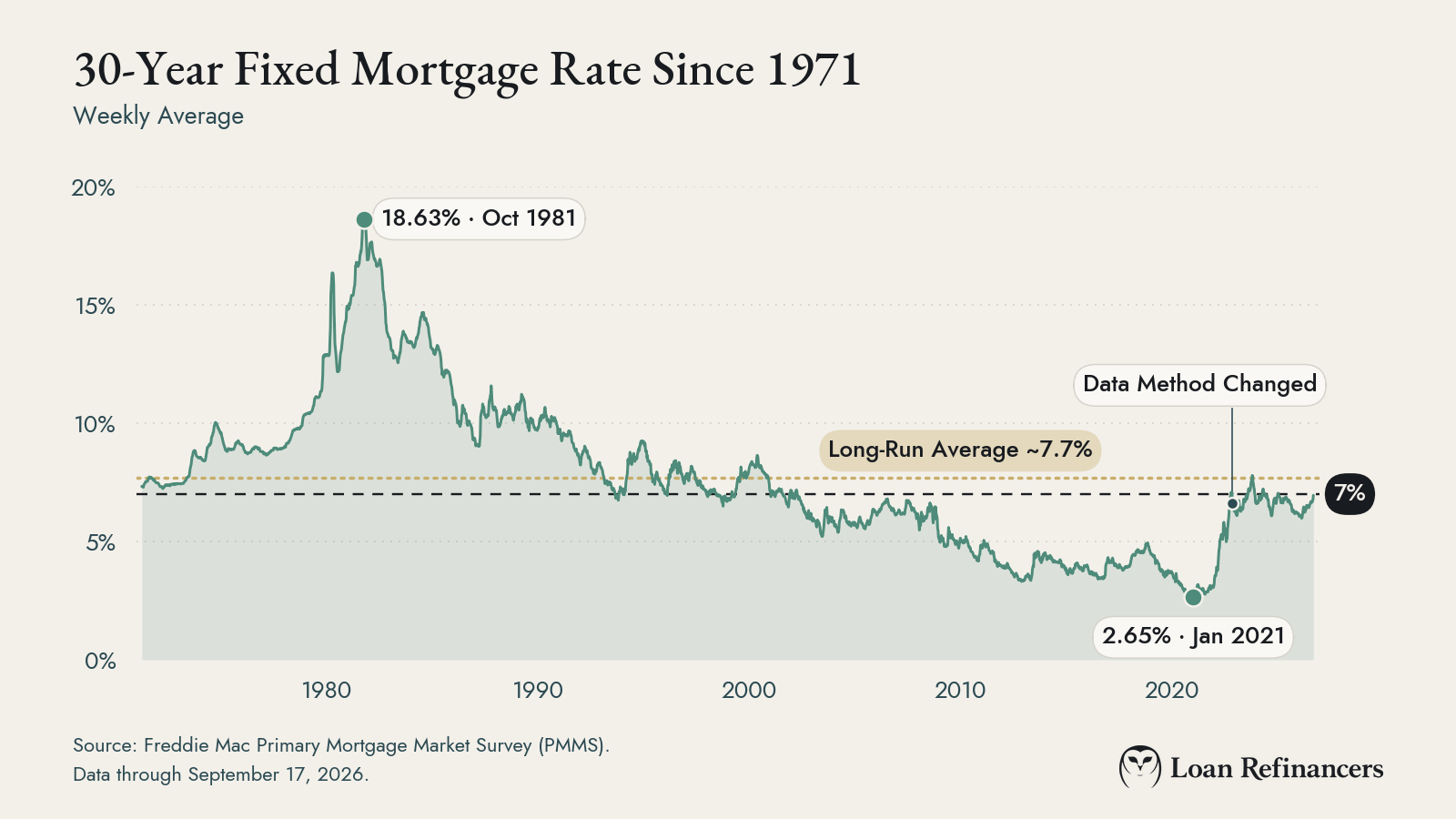
The years from 2010 through 2021 are the outlier. Annual averages stayed below 5% for that entire stretch (per Freddie Mac PMMS), which is why 7% can feel high to anyone who borrowed during it.
How common is a rate above 7%? Across every weekly reading since April 1971, the 30-year fixed rate has been above 7% about 54% of the time (per Freddie Mac PMMS, through September 2026). Since 2000, that share drops to roughly 8%. Both figures come from the same series, which shows how much your sense of “normal” depends on when you started paying attention.
One caution. Freddie Mac changed how it collects this data in November 2022, moving from a lender survey to rate data from loan applications. Treat long-run comparisons as directional, not exact. To see what moves rates, read our guide to how to read mortgage rate trends.
Is a 7% mortgage rate high compared to today’s rates?
Compare it to what the market offers right now. This comparison matters most, because a rate is only “high” if a meaningfully lower one is within reach.
The easiest benchmark is the 30-year fixed average on Freddie Mac’s PMMS page, updated every Thursday at noon Eastern. Freddie Mac builds it from home-purchase applications with good or excellent credit and 20% down, so your own offer can land higher or lower.
Subtract that average from your rate. The result is your gap. Many homeowners start running the numbers once the gap reaches roughly 0.75 to 1 percentage point, but that’s a rule of thumb, not a verdict. A small gap may not cover the cost of refinancing. Our refinance timing guide covers the rule in detail.
How do I know if my mortgage rate is high?
Run three checks against your own loan.
- Your rate gap. Compare your rate to what the market offers a borrower like you. Credit score, home equity, loan size, and loan type all shift the rate you can get.
- Your break-even point. This is the month your savings repay the closing costs of a refinance. The formula is closing costs ÷ monthly payment savings = months to break even. Illustrative example only: $6,000 in closing costs and $150 in monthly savings gives 40 months, or about three years and four months.
- Your time horizon. If you expect to sell or move before your break-even point, a lower rate may not pay for itself.
Our free refinance calculator runs all three checks at once. Enter your remaining balance, current rate, remaining term, a new rate, and estimated closing costs. It returns your monthly savings, break-even point, and total interest difference, with no signup and no credit check. For typical costs, see how much it costs to refinance.
If all three checks point the same way, your rate is “high” in the way that matters. If they don’t, it may simply be a rate you’re fine keeping.
How much does a 7% mortgage rate cost per month?
Rate gaps feel abstract until you see them in a payment. Illustrative example only: on a $300,000 30-year fixed loan, principal and interest at 7% comes to about $1,996 a month. At 6.5%, it’s about $1,896. At 6%, it’s about $1,799. That’s roughly $100 and $197 less per month, before taxes and insurance.
Those gaps are what your break-even math measures against. A $100 monthly difference and $6,000 in closing costs, for example, takes 60 months to break even, not the 40 in the earlier example. The same gap can look different depending on your costs and how long you plan to stay.
Does a high mortgage rate mean I should refinance?
Not automatically. A rate can sit above the market and still not be worth changing. Closing costs, a short stay in the home, or a new 30-year term that restarts your loan clock can each cancel out the savings. Sometimes the honest answer is to wait and keep watching. If a move is on the horizon, read is refinancing worth it if you’re moving in 2 years.
Other times the gap is large enough, and your time horizon long enough, that the math works. The three checks let the numbers decide, not a headline about rates.
Note: This analysis is for informational purposes only and does not constitute financial advice. Your situation may differ. Consult a licensed mortgage professional before making refinancing decisions.
Frequently Asked Questions
Is 7% a good mortgage rate?
“Good” depends on the same three yardsticks. A 7% rate sits just below the long-run average and well above most rates from 2010 through 2021. Compared with today’s market, it can land above or below, depending on the week. Whether it’s good for you comes down to your gap, break-even point, and time horizon.
Will mortgage rates go back down?
No one can say with certainty. Mortgage rates move with bond market yields, Federal Reserve policy, inflation, and broader economic conditions. Instead of guessing, many homeowners track their own rate against the market and act only when the math works. That’s what Rate Watch is built to do.
How often does Freddie Mac update its mortgage rate average?
Weekly. Freddie Mac publishes the PMMS on Thursdays at noon Eastern, or on Wednesday when a U.S. holiday falls on Thursday.
The Bottom Line: Is a 7% Mortgage Rate High?
Whether a 7% mortgage rate is high comes down to three comparisons: history, today’s market, and your own loan. Only one of them changes week to week, and it’s the one you can monitor without effort.
If you’d like to know when the market moves in your favor, Rate Watch monitors it for you. Prefer to run the numbers yourself? Use the refinance calculator.
No credit pull. No SSN. No pressure.